Paul Levy Explains Why Philadelphia Lags Behind on Economic Growth
Moving Frontwards
In a new report, Paul Levy lays bare why Philly lags behind in economic growth … and what we can do most it.
Feb. 15, 2017


Final week, in response to Mayor Kenney'southward almanac address to the Greater Philadelphia Chamber of Commerce, I wrote near the apparent famine of innovative job creation strategies coming out of the Mayor'due south office. Nationwide, I posited, cities have become engines of economic growth by beingness laboratories of experimentation. Here, we seem wedded to a lot of one-time-school taxation and spend, redistributive thinking. I looked around and highlighted some ideas that seem to be working elsewhere and asked: Why not hither?
I didn't even mention how, by ignoring the common sense prescriptions of not ane but ii taxation reform commissions, we've disadvantaged ourselves when competing with other cities and suburban counties for talent and jobs. Now comes a new study that brilliantly lays out the degree to which nosotros've long been our own worst enemy when it comes to growing the local economy, and that reiterates the transformative furnishings of reforming our tax arrangement.
Philadelphia: An Incomplete Revival, released final month by the Center City District (CCD), both diagnoses and prescribes. I caught up with Paul Levy, president and CEO of CCD and long one of our most thoughtful policy minds. Information technology was Levy, along with Brandywine Realty Trust CEO Jerry Sweeney, who put together the diverse grouping calling itself the Philadelphia Growth Coalition—a mix of Democrats and Republicans, labor and businessmen leaders—which has made real progress agitating for increasing commercial property taxes past fifteen per centum and dedicating those additional revenues to lowering wage and business taxes. The idea is to decrease taxing what can motion—people—and increase taxing what tin can't—buildings.
Larry Platt: Your report does a swell job of laying out the current state of things. Can you lot summarize where we are in terms of economic growth?
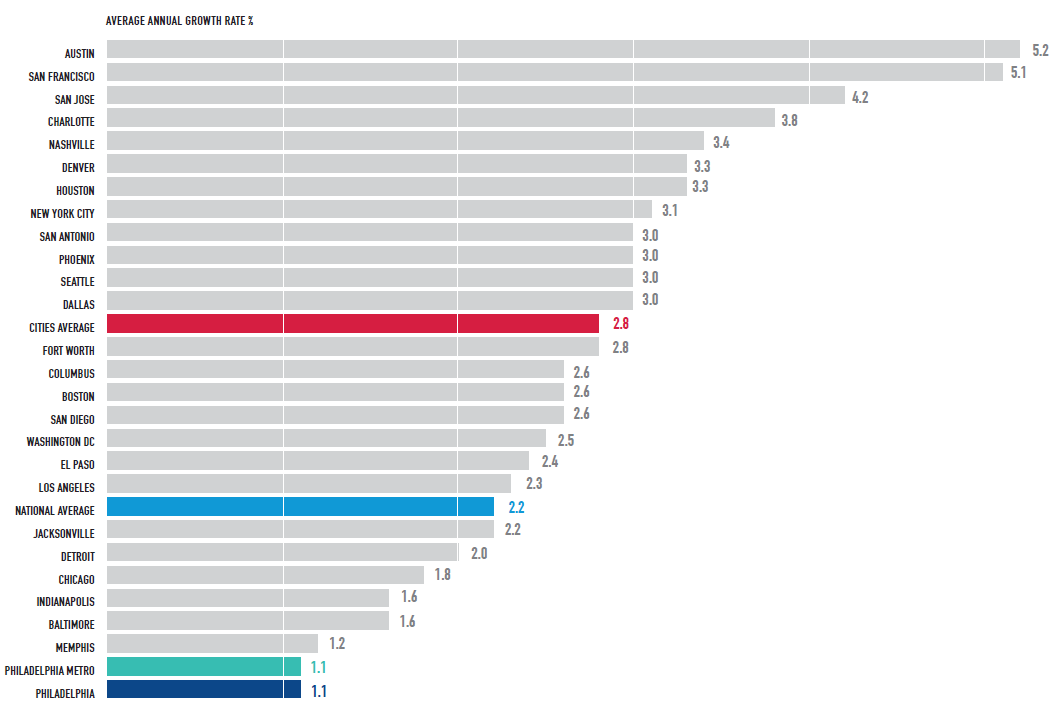
Paul Levy: Offset, you lot're right when you lot say that cities have outperformed the national economic system since the Great Recession. The 25 largest have grown at 2.8 percent between 2010 and 2015, compared to ii.2 percent nationally. Simply Philadelphia'southward growth is at i.ane pct. That's slower growth than we see in Detroit and Baltimore. That may seem out of sync with what we see in Centre City and University Metropolis, but that'southward why we telephone call this An Incomplete Revival.
Average Annual Growth in Private Wages and Bacon Jobs, 2010-2015 (click to zoom)
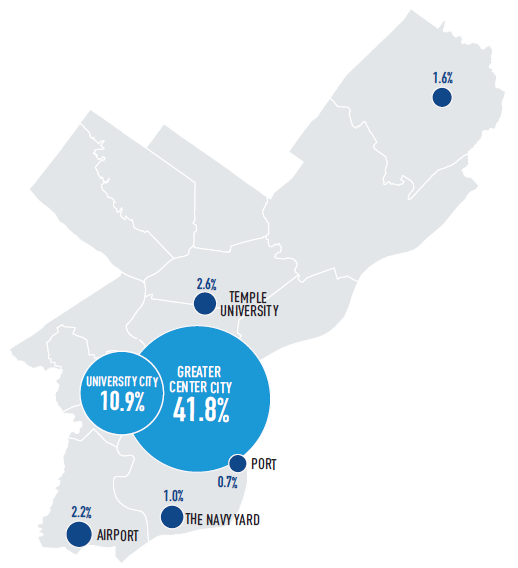
LP: In fact, the written report points out that over half of all jobs are in Center Urban center and University City. Merely that wasn't the nearly surprising statistic. The number of those making a reverse commute out of the city stunned me.
Levy: Yes, 39 pct of metropolis residents are reverse commuting to jobs in the suburbs. In New York, for example, that number is at 15 percentage. And it's not merely Center Metropolis immature professionals. A huge number of people in North Philadelphia and Olney are taking the Broad Street Line and the 125 or 126 motorbus out to the Rex of Prussia Mall to work retail jobs. They're traveling an hour each way. It's not that they don't have the energy or commitment to work. We only don't have the jobs hither for them.
LP: You mention immature professionals. Many of usa—and I may be guilty of this—have hyped Philadelphia's influx of millennials. How meaningful is that demographic change?
Levy: It's a actually good matter. But it's a misreading of the data if yous think it'southward going to be transformative—considering it's fourth dimension limited. We've already passed the elevation of the Millennial trend, which happened in 2015.
Philadelphia's Major Job Nodes, Percent of Citywide Employment (click to zoom)
LP: And that Pew written report a few years agone found that many of them experience that, if we don't prepare the schools, they'll be off to the suburbs in a few years.
Levy: Really, people remember it that fashion, simply they actually listed job growth first and schools 2d as the reason they might ultimately leave. Let me find information technology here. [Shuffling papers.] Yeah, hither it is. The top two reasons you expect to exit the city: 38 percent said jobs/career and 29 percent said schools. Only 10 percentage said they'd go out because they'd prefer the suburban lifestyle. This is a moment of great opportunity for Philadelphia, because we're a city with then many incredible amenities. We're walkable, affordable, vibrant. But we're at the bottom of the pack in terms of task growth.
LP: The report lays out the challenges we face up in having the nation's highest poverty charge per unit (25 percentage) and highest child poverty charge per unit (38 percent) in the nation. But information technology also explains how that came to be and links it to policies that accept stymied task growth.
Levy: That'south right. Our poverty rate is terrible, merely it's not that the actual number of people in poverty skyrocketed. It's that so many working-class and middle-course residents left the city. Between 1970 and 2000, the number of middle-income residents who moved out of the city was 12 times greater than the number of residents added to the poverty rolls during that fourth dimension. Had we not had a loss of a one-half-1000000 working-class and heart-class residents during those 3 decades, our poverty rate would accept been 17 percent in 2000 instead of 23 percent. That's a large divergence.
LP: And that gets united states of america to the idea that our tax policy has helped fuel that loss to the suburbs.
Levy: Nosotros're not suggesting that tax reform is a panacea. But at that place'due south no question that our tax construction has been pushing jobs out of the metropolis. Retrieve near this: If you're living in Philadelphia and working in Male monarch of Prussia or anywhere in the suburbs, you're paying a wage tax of 3.ix percent. If you lot motility close to your task in the suburbs, you lot get an automatic pay increase of almost 3 percent considering most counties have no more than a ane percent earnings tax. And then the wage revenue enhancement creates an incentive for workers to decamp from the city. And employers will tell you lot it impacts them as well, because they accept to increase salaries to compensate for the wage tax if they want to attract workers who alive in the suburbs.
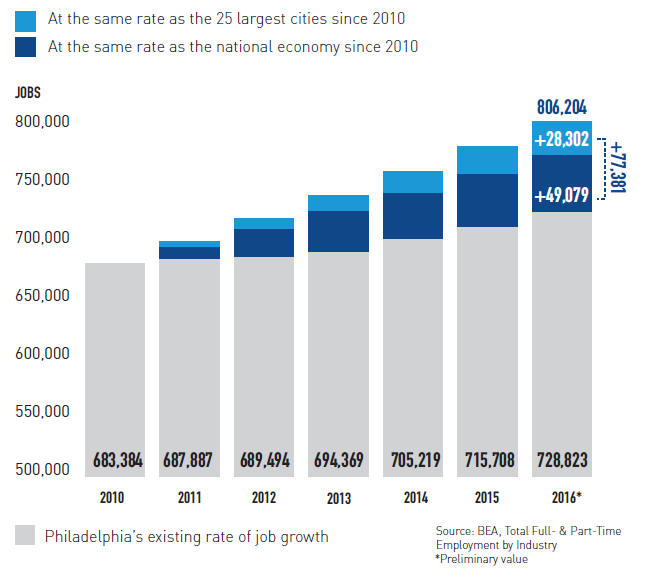
If Philadelphia Grew Faster... (click to zoom)
LP: In recent years, Philadelphia has seen its beginning population growth since the 1960s. But that doesn't mean we're still not losing people to the suburbs, right?
Levy: Correct. Philadelphia'south population grew because births outnumbered death in the city and we benefitted from a new wave of international immigration—something that is seriously challenged today. Domestically, nosotros see the 5,000 in-movers per year from Montgomery County—the millennials and empty nesters. But what we don't see are the ten,000 residents each year who decamp to Montgomery County. And, yes, the millennial surge is great. Just for all the focus on them, the fact is if y'all have out immigrants, nosotros'd still be losing population.
LP: Clearly our tax structure harkens back to a time when the city could tax wages considering the jobs were here. But at present, in the most mobile of societies, we're withal taxing what can move. Where practise we stand with amending the state Constitution so nosotros can tax commercial property at a college charge per unit?
Levy: Last summer, HB 1871 was passed by the General Associates. It needs to pass once again this year before it can be placed on the election for a vote. We experience good. We've got the mayor's support, and in the adjacent couple of weeks we promise to movement forward with him and a coalition of Democrats, Republicans, labor and business leaders. This doesn't tie the urban center's hands; it allows us to compete.
LP: It'south a long slog to amend the Constitution.
Levy: I jokingly say to people, we've made it over the Appalachian Mountains, I can come across the Rockies in front end of united states, and the High Sierras in the altitude. But we're moving forward.
Photo header: Flickr/Jamesy Pena 
hellerlonater1944.blogspot.com
Source: https://thephiladelphiacitizen.org/paul-levy-economic-growth-philadelphia/
Post a Comment for "Paul Levy Explains Why Philadelphia Lags Behind on Economic Growth"