What Type of Responsibility Obliges a Soldier to Exercise Reasonable
Command responsibility, also chosen superior responsibility, the Yamashita standard, or the Medina standard, is the legal doctrine of hierarchical accountability for war crimes.[1] [2] [3] [4] [5] The legal doctrine of Control Responsibleness was codification in the Hague Conventions of 1899 and 1907, and is partly based upon the American Lieber Code, a war transmission for the Union forces, authorized by United states of america President Abraham Lincoln in 1863, two years into the course of the American Civil State of war. The legal doctrine of command responsibility was first applied past the German Supreme Court, in the Leipzig War Crimes Trials (1921), which included the trial of Regal German Army officeholder Emil Müller for the war crimes that he committed during the First World War (1914–1918).[half dozen] [seven] [8]
The Yamashita standard derived from the incorporation to the U.S. Code of the legal doctrine of control responsibility, equally codified in the two Hague Conventions. That legal precedent, decided by the U.S. Supreme Courtroom, immune the US prosecution of the war-crimes example against General Tomoyuki Yamashita for the atrocities committed by his soldiers in the Philippine Islands, in the Pacific Theatre (1941–1945) of the Second World War. A Usa military tribunal charged Yamashita with "unlawfully disregarding, and declining to discharge, his duty equally a commander to control the acts of members of his control, by permitting them to commit war crimes."[9] [ten]
The Medina standard expanded the United states of america Code to include the criminal liability of United states armed services officers for the war crimes committed past their subordinates, equally are war machine officers of an enemy power, e.g. the war-crimes trial of Gen. Yamashita in 1945. The Medina standard originated from the charging, prosecution, and court-martial of U.Southward. Ground forces Captain Ernest Medina in 1971, for not exercising his superior responsibility as company commander, past not acting to halt the commission of a war crime past his soldiers, the My Lai Massacre (xvi March 1968), during the Vietnam State of war (1955–1975).[9] [11] [12] [xiii]
Origin [edit]
Developing accountability [edit]

Hagenbach on trial, from Berner Chronik des Diebold Schilling dem Älteren
In The Art of State of war, written during the 6th century BC, Lord's day Tzu argued that a commander's duty was to ensure that his subordinates conducted themselves in a civilised manner during an armed conflict. Similarly, in the Bible (Kings 1: Affiliate 21), within the story of Ahab and the killing of Naboth, King Ahab was blamed for the killing of Naboth on orders from Queen Jezebel, because Ahab (as king) was responsible for everyone in his kingdom.
The trial of Peter von Hagenbach by an advert hoc tribunal of the Holy Roman Empire in 1474, was the get-go "international" recognition of commanders' obligations to act lawfully.[xiv] [15] Hagenbach was put on trial for atrocities committed during the occupation of Breisach, found guilty of war crimes and beheaded.[16] Since he was convicted for crimes "he as a knight was deemed to accept a duty to prevent", Hagenbach defended himself past arguing that he was only following orders[14] [17] from the Duke of Burgundy, Charles the Bold, to whom the Holy Roman Empire had given Breisach.[18] Despite the fact no explicit apply of a doctrine of "command responsibility" existed, it is seen as the first trial based on this principle.[16] [19]
During the American Civil War, the concept developed further, as can exist seen in the "Lieber Code". This regulated accountability past imposing criminal responsibility on commanders for ordering or encouraging soldiers to wound or kill already disabled enemies.[xiv] [19] Article 71 of the Lieber Code provided that:
Whoever intentionally inflicts additional wounds on an enemy already wholly disabled, or kills such an enemy, or who orders or encourages soldiers to do and so, shall suffer death, if duly convicted, whether he belongs to the Army of the U.s.a., or is an enemy captured after having committed his criminality.[twenty] [21]
The Hague Convention of 1899 was the kickoff effort at codifying the principle of command responsibility on a multinational level and was reaffirmed and updated entirely by the Hague Convention of 1907. The doctrine was specifically constitute within "Laws and Customs of War on Land" (Hague Four); October 18, 1907: "Department I on Belligerents: Chapter I The Qualifications of Belligerents", "Section III Armed services Authority over the territory of the hostile State",[22] and "Adaptation to Maritime War of the Principles of the Geneva Convention" (Hague X); October 18, 1907.[23] Commodity 1 of Section I of the 1907 Hague IV stated:
The laws, rights, and duties of war utilise not just to armies, just also to militia and volunteer corps fulfilling these conditions:
- To be commanded past a person responsible for his subordinates
- To accept a fixed distinctive emblem recognizable at a distance
- To conduct arms openly
- To deport their operations in accord with the laws and customs of war
Another example of command responsibility is shown in Article 43 of Section Three of the same convention, which stipulated:
The authority of the legitimate power having in fact passed into the hands of the occupant, the latter shall have all the measures in his power to restore, and ensure, as far as possible, public society and prophylactic, while respecting, unless absolutely prevented, the laws in force in the country.
In "Accommodation to Maritime War of the Principles of the Geneva Convention" (Hague X), Commodity 19 stated:
The commanders in chief of the belligerent fleets must arrange for the details of carrying out the preceding articles, as well every bit for cases non covered thereby, in accordance with the instructions of their respective Governments and in conformity with the general principles of the present Convention.
While the Hague Conventions of 1899 and 1907 do not explicitly create a doctrine of command responsibility, they do uphold a notion that a superior must account for the actions of his subordinates. It also suggests that military superiors have a duty to ensure that their troops human activity in accord with international law and if they fail to control them lawfully, their corresponding states may be held criminally liable. In turn, those states may choose to punish their commanders. At such, the Hague Conventions of 1899 and 1907 have been viewed as foundational roots of the modern doctrine of control responsibility.[21] [24] After Earth State of war I, the Centrolineal Powers' Commission on the Responsibleness of the Authors of the War and on the Enforcement of Penalties recommended the institution of an international tribunal, which would try individuals for "order[ing], or, with knowledge thereof and with power to intervene, abjure[ing] from preventing or taking measures to prevent, putting an end to or repressing, violations of the laws or customs of war."[19]
Since the cease of the Common cold War, private contractors take become more than prevalent in zones of conflict. Both political and legal scholars highlight the multiple challenges this has introduced when tracing the responsibility of crimes in the field. Some, such as Martha Lizabeth Phelps, go as far to claim that if hired contractors are indistinguishable from national troops, the contractors infringe the country's legitimacy.[25] The control responsibility of actions in warfare get increasingly unclear when actors are viewed as existence role of a state's strength, but are, in truth, private actors.
Introducing responsibility for an omission [edit]

Command responsibility is an omission mode of individual criminal liability: the superior is responsible for crimes committed by his subordinates and for failing to foreclose or punish (equally opposed to crimes he ordered). In re Yamashita earlier a United States armed services committee in 1945, General Yamashita became the first to exist charged solely on the basis of responsibility for an omission. He was commanding the 14th Area Ground forces of Nihon in the Philippines during the Pacific Theater of World War Two when some of the Japanese troops engaged in atrocities against thousands of civilians and prisoners of war. As commanding officeholder, he was charged with "unlawfully disregarding and failing to discharge his duty every bit a commander to control the acts of members of his command by permitting them to commit war crimes."
By finding Yamashita guilty, the Commission adopted a new standard, stating that if "vengeful actions are widespread offenses and there is no effective try by a commander to discover and control the criminal acts, such a commander may exist held responsible, even criminally liable." However, the cryptic wording resulted in a long-standing contend virtually the amount of knowledge required to constitute command responsibility. The matter was appealed, and was affirmed by the The states Supreme Court in 1946.[26] After sentencing, Yamashita was executed.
Following In re Yamashita, courts clearly accepted that a commander's actual knowledge of unlawful actions is sufficient to impose private criminal responsibility.[nine] [19]
In the Loftier Command Case (1947–1948), the U.S. military tribunal argued that in order for a commander to be criminally liable for the actions of his subordinates "in that location must be a personal dereliction" which "tin can simply occur where the deed is directly traceable to him or where his failure to properly supervise his subordinates constitutes criminal negligence on his part" based upon "a wanton, immoral disregard of the activeness of his subordinates amounting to acquiescence."[7] [9] [19]
In the Hostage Case (1947–1948), the U.S. armed services tribunal seemed to limit the situations in which a commander has a duty to know to instances if he already has some data regarding subordinates' unlawful actions.[seven] [ix] [xix]
After Earth War II, the parameters of control responsibleness were thus increased, imposing liability on commanders for their failure to prevent the commission of crimes by their subordinates. These cases, the last ii parts of the Subsequent Nuremberg Trials, discussed explicitly the requisite standard of mens rea (roughly, "guilty knowledge") and were unanimous in finding that a lesser level of knowledge than bodily noesis may be sufficient.[19]
Codified [edit]
The starting time international treaty to comprehensively codify the doctrine of command responsibility was the Boosted Protocol I ("AP I") of 1977 to the Geneva Conventions of 1949.[six] [8] [nine] Article 86(2) states that:
the fact that a alienation of the Conventions or of this Protocol was committed by a subordinate does not atone his superiors from ... responsibility ... if they knew, or had data which should have enabled them to conclude in the circumstances at the time, that he was committing or about to commit such a breach and if they did not take all feasible measures within their power to foreclose or repress the breach.
Commodity 87 obliges a commander to "forestall and, where necessary, to suppress and report to competent authorities" any violation of the Conventions and of AP I.
In Article 86(2) for the first time a provision would "explicitly address the noesis cistron of command responsibility".[7] [nine] [nineteen]
Definitions [edit]
In the discussion regarding "command responsibility" the term "command" tin can exist defined as
A. De jure (legal) command, which can be both military machine and civilian. The determining factor here is non rank but subordination. Four structures are identified:[6] [vii]
- Policy command: heads of state, high-ranking authorities officials, monarchs
- Strategic control: War Cabinet, Joint Chiefs of Staff
- Operational command: war machine leadership. In Yamashita information technology was established that operational command responsibility cannot exist ceded for the purpose of the doctrine of control responsibleness; operational commanders must exercise the full potential of their dominance to forestall war crimes – failure to supervise subordinates or non-assertive orders does non exonerate the commander.
- Tactical control: direct command over troops on the ground
International example law has developed two special types of "de jure commanders."
- Prisoners-of-war (Pow) camp commanders: the ICTY established in Aleksovski that Pw camp commanders are entrusted with the welfare of all prisoners, and subordination in this case is irrelevant.
- Executive commanders: supreme governing say-so in the occupied territory. Subordination is again irrelevant – their responsibility is the welfare of the population in the territory under their control, as established in the High Control and Hostages cases after Globe War II.
B. De facto (factual) command, which specifies effective control, as opposed to formal rank. This needs a superior-subordinate relationship. Indicia (discriminating marks) are:[6] [7]
- Capacity to issue orders.
- Power of influence: influence is recognized every bit a source of dominance in the Ministries case before the US armed forces Tribunal after World War 2.
- Show stemming from distribution of tasks: the ICTY has established the Nikolic examination – superior condition is deduced from analyzing distribution of tasks within the unit, and the test applies both to operational and POW camp commanders.
Additional Protocol I and the Statutes of the ICTY, the ICTR, and the ICC makes prevention or prosecution of crimes mandatory.[half-dozen]
Awarding [edit]
Nuremberg Tribunal [edit]
Post-obit World War II, communis opinio was that the atrocities committed by the Nazis were so severe a special tribunal had to be held. However, gimmicky jurists such as Harlan Fiske Rock criticized the Nuremberg Trials as victor'south justice. The Nuremberg Charter determined the basis to prosecute people for:[14]
| Offense | Clarification |
|---|---|
| Crimes confronting peace | the planning, preparation, initiation or waging of a war of aggression, or a war in violation of international treaties, agreements or assurances, or participation in a common programme or conspiracy for the achievement of whatever of the foregoing. |
| War crimes | violations of the laws and customs of war. A listing follows with, inter alia, murder, ill-treatment or deportation into slave labour or for any other purpose of the noncombatant population of or in occupied territory, murder or sick-treatment of prisoners of war or persons on the seas, the killing of hostages, the plunder of public or individual property, the wanton destruction of cities, towns or villages, or devastation non justified by war machine necessity. |
| Crimes against humanity | murder, extermination, enslavement, deportation, and other inhuman acts committed against any civilian population, before or during the war, or persecutions on political, racial or religious grounds in execution of or in connection with whatsoever crime within the jurisdiction of the Tribunal, whether or not in violation of the domestic police force of the state where perpetrated. |
The jurisdiction ratione personae is considered to employ to "leaders, organisers, instigators and accomplices" involved in planning and committing those crimes.[14]
International Criminal Tribunal for the sometime Yugoslavia [edit]
The ICTY statute commodity seven (3) establishes that the fact that crimes "were committed by a subordinate does not relieve his superior of criminal responsibility if he knew or had reason to know that the subordinate was about to commit such acts or had done so and the superior failed to take the necessary and reasonable measures to prevent such acts or to punish the perpetrators."[19]
In The Prosecutor five. Delalić et al. ("the Čelebići example") first considered the scope of command responsibility past concluding that "had reason to know" (article 7(3)) means that a commander must have "had in his possession data of a nature, which at the least, would put him on notice of the risk of ... offences by indicating the need for boosted investigation in guild to ascertain whether ... crimes were committed or were well-nigh to be committed by his subordinates."[vii] [9] [nineteen]
In The Prosecutor five. Blaškić ("the Blaškić case") this view was corroborated. Withal, information technology differed regarding mens rea required by AP I. The Blaškić Trial Chamber concluded that "had reason to know", equally defined by the ICTY Statute, likewise imposes a stricter "should have known" standard of mens rea.[9] [19]
The conflicting views of both cases were addressed by the Appeals Chambers in Čelebići and in a split decision in Blaškić. Both rulings hold that some information of unlawful acts by subordinates must be available to the commander following which he did not, or inadequately, discipline the perpetrator.[vi] [7] [nine] [19]
The concept of command responsibility has developed significantly in the jurisprudence of the ICTY. Ane of the nigh recent judgements that extensively deals with the subject is the Halilović sentence[27] of 16 November 2005 (para. 22-100).
International Criminal Tribunal for Rwanda [edit]
The United Nations Security Quango Resolution 955 (1994) set up an international criminal tribunal to judge people responsible for the Rwandan genocide and other serious violations of international law in Rwanda, or past Rwandan citizens in nearby states, between 1 Jan and 31 December 1994;[28] additional later resolutions expanded the scope and timeline of the tribunal. The tribunal has jurisdiction over genocide, crimes against humanity, and state of war crimes.
The judgement against Jean-Paul Akayesu established rape as a war crime. Rape was placed in line with "other acts of serious bodily and mental harm"[29] rather than the historical view of rape as "a trophy of war."[30] Akayesu was held responsible for his deportment and not-actions equally mayor and constabulary commander of a district in which many Tutsis were killed, raped, tortured, and otherwise persecuted.
Some other case prosecuted persons in charge of a radio station and a newspaper that incited and and then encouraged the Rwandan genocide. The defendants were charged with genocide, incitement to genocide, and crimes against humanity for their positions of control and command in the "detest media," although they physically had non committed the acts.
International Criminal Court [edit]

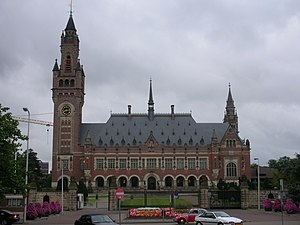
The International Criminal Courtroom in The Hague
Following several ad hoc tribunals, the international customs decided on a comprehensive court of justice for hereafter crimes against humanity. This resulted in the International Criminal Court, which identified iv categories.[xiv]
- Genocide
- Crimes against humanity
- State of war crimes
- Crimes of aggression
Article 28 of the Rome Statute of the International Criminal Court codification the doctrine of command responsibility.[9] With Commodity 28(a) military commanders are imposed with individual responsibility for crimes committed by forces under their effective command and command if they:
either knew or, owing to the circumstances at the time, should take known that the forces were committing or about to commit such crimes.[8] [9] [19]
It uses the stricter "should have known" standard of mens rea, instead of "had reason to know," as defined by the ICTY Statute.[7] [xix] Although the ICC Pre-Trial Chamber established a test for the "should have known" standard during the prosecution of Jean-Pierre Bemba, it has never been tested because Bemba had "bodily knowledge" of crimes by his subordinates.[31]
The Bush-league administration has adopted the American Servicemembers' Protection Act and entered in Commodity 98 agreements in an effort to protect any The states citizen from appearing before this court. As such it interferes with implementing the control responsibility principle when applicative to U.s.a. citizens.[32]
War on terror [edit]

A number of commentators have advanced the statement that the principle of "command responsibility" could brand high-ranking officials within the Bush-league administration guilty of war crimes committed either with their noesis or past persons under their control.[33]
As a reaction to the September 11, 2001 attacks, the US authorities adopted several controversial measures (e.g., asserting "unlawful combatant" status and "enhanced interrogation methods"[34]).
Alberto Gonzales and others argued that detainees should be considered "unlawful combatants" and equally such not be protected by the Geneva Conventions in multiple memoranda regarding these perceived legal grey areas.[35]
Gonzales' statement that denying coverage under the Geneva Conventions "substantially reduces the threat of domestic criminal prosecution nether the War Crimes Act" suggests, at the least, an sensation past those involved in crafting policies in this expanse that U.S. officials are involved in acts that could be seen to be war crimes.[36] The U.S. Supreme Court overruled the premise on which this argument is based in Hamdan five. Rumsfeld, in which it ruled that Common Article 3 of the Geneva Conventions applies to detainees in Guantanamo Bay, and that the Guantanamo military machine commission used to try these suspects were in violation of U.South. and international police force because information technology was not created by Congress.[37]
On April 14, 2006, Human being Rights Spotter said that Secretary Donald Rumsfeld could exist criminally liable for his alleged interest in the abuse of Mohammad al-Qahtani.[38] Dave Lindorff contends that by ignoring the Geneva Conventions. the U.S. assistants, including President Bush-league, every bit Commander-in-Chief, is culpable for state of war crimes.[39] In addition, quondam master prosecutor of the Nuremberg Trials Benjamin Ferencz has called the invasion of Iraq a "clear alienation of law", and equally such it constitutes a crime against peace.[40] On Nov 14, 2006, invoking universal jurisdiction, legal proceedings were started in Germany - for their alleged involvement of prisoner abuse - against Donald Rumsfeld, Alberto Gonzales, John Yoo, George Tenet and others.[41] This allegedly prompted recently retired Donald Rumsfeld to abolish a planned visit to Germany.
Former Army Lieutenant Ehren Watada refused to exist deployed to Republic of iraq based on his claims of command responsibleness. Although his own deployment was not ordered until after Security Council Resolution 1511 authorized a multinational force in Republic of iraq,[42] Watada argued that the invasion of Iraq was illegal, and equally such he claimed he was spring past command responsibility to reject to have role in an illegal war. He was discharged from the Army in 2009.
The Military Commissions Act of 2006 is seen as an amnesty police for crimes committed in the War on Terror by retroactively rewriting the War Crimes Act[43] and past abolishing habeas corpus, effectively making it incommunicable for detainees to challenge crimes committed against them.[44]
Luis Moreno-Ocampo told The Sunday Telegraph that he is willing to start an enquiry past the International Criminal Courtroom (ICC), and possibly a trial, for war crimes committed in Iraq involving British Prime number Government minister Tony Blair and American President George West. Bush-league,[45] even though under the Rome Statute the ICC has no jurisdiction over Bush-league, since the United States is not a State Party to the relevant treaty—unless Bush were accused of crimes inside a State Political party, or the United nations Security Quango (where the United States has a veto) requested an investigation. Withal, Blair does fall under ICC jurisdiction equally Britain is a State Party.
Nat Hentoff wrote on August 28, 2007, that a leaked written report by the International Committee of the Red Cross and the July 2007 report by Homo Rights First and Physicians for Social Responsibility, titled Leave No Marks: Enhanced Interrogation Techniques and the Risk of Misdeed, might be used every bit evidence of American war crimes if there was a Nuremberg-like trial regarding the War on Terror.[46]
Presently before the end of President Bush's second term, newsmedia in other countries started opining that nether the United Nations Convention Against Torture, the United States is obligated to agree those responsible for prisoner abuse to business relationship under criminal law.[47] One proponent of this view was the United nations special rapporteur on torture and other brutal, inhuman or degrading treatment or penalty (Professor Manfred Nowak) who, on Jan xx, 2009, remarked on German language television that sometime president George W. Bush had lost his head of land immunity and under international constabulary, the United States would now exist mandated to start criminal proceedings against all those involved in these violations of the United nations Convention Against Torture.[48] Constabulary professor Dietmar Herz explained Nowak's comments by saying that under U.S. and international law sometime President Bush is criminally responsible for adopting torture as an interrogation tool.[48]
State of war in Darfur [edit]
Human being Rights Lookout man commented on this disharmonize past stating that:
... private commanders and noncombatant officials could be liable for declining to take any activity to end abuses by their troops or staff ... The principle of command responsibility is applicable in internal armed conflicts too every bit international armed conflicts.[49]
The Dominicus Times in March 2006, and the Sudan Tribune in March 2008, reported that the UN Panel of Experts determined that Salah Gosh and Abdel Rahim Mohammed Hussein
had "command responsibility" for the atrocities committed by the multiple Sudanese security services.[l]
Following an inquiry by the United Nations, regarding allegations of involvement of the Government in genocide, the dossier was referred to the International Criminal Courtroom.[50] On May two, 2007, the ICC issued arrest warrants for militia leader Ali Muhammad al-Abd al-Rahman, of the Janjaweed, a.k.a. Ali Kushayb, and Ahmad Muhammad Haroun for crimes against humanity and war crimes.[50] To this 24-hour interval Sudan has refused to comply with the arrest warrants and has not turned them over to the ICC.[51]
The International Criminal Courtroom'southward chief prosecutor, Luis Moreno-Ocampo, announced on July 14, 2008, ten criminal charges confronting President Omar al-Bashir, accusing him of sponsoring war crimes, genocide, and crimes against humanity.[52] The ICC'south prosecutors take charged al-Bashir with genocide considering he "masterminded and implemented a plan to destroy in substantial part" iii tribal groups in Darfur because of their ethnicity.[52] The ICC'south prosecutor for Darfur, Luis Moreno-Ocampo, is expected within months to inquire a console of ICC judges to issue an arrest warrant for Bashir.[52]
Zimbabwe [edit]
For his conduct every bit President of Zimbabwe, including allegations of torture and murder of political opponents, information technology was suggested Robert Mugabe may be prosecuted using this doctrine.[53] Considering Zimbabwe has non subscribed to the International Criminal Court's jurisdiction it may be authorised by the United Nations Security Quango. The precedent for this was set past its referral to bring indictments relating to the crimes committed in Darfur.[54]
See also [edit]
- Articulation criminal enterprise
- Cases earlier the International Criminal Courtroom
- Rule of Law in Armed Conflicts Project
- Carl Schmitt
- Crime against humanity
- Crime against peace
- Geneva Conventions
- Genocide
- Impunity
- International humanitarian law
- International law
- Jus advertisement bellum
- Jus in bello
- Listing of state of war crimes
- List of war criminals
- Nuremberg Charter
- Nuremberg Principles
- Parental responsibility
- Peace Palace
- Respondeat superior
- Superior orders
- The Buck Stops Here
- Universal jurisdiction
- Vicarious liability
- State of war crimes
- State of war Crimes Deed of 1996
Notes [edit]
- ^ Guilty Associations: Articulation Criminal Enterprise, Command Responsibility, and the Evolution of International Criminal Law Archived 10 September 2006 at the Wayback Motorcar by Allison Marston Danner and Jenny Southward. Martinez, September 15, 2004
- ^ Control Responsibility - An International Focus by Anne Eastward. Mahle, PBS
- ^ Command, superior and ministerial responsibility by Robin Rowland, CBC News Online, 6 May 2004
- ^ Superior responsibility (Prosecutor 5. Popović et al, ICTY TC II, x June 2010 (case no. Information technology-05-88-T). p. 511)
- ^ David Isenberg (13 January 2013). "Lawbreakers at War: How Responsible Are They?". Time . Retrieved 26 April 2018.
- ^ a b c d east f Command Responsibility: The Gimmicky Law at the Wayback Machine (archive index) past Iavor Rangelov and Jovan Nicic, Humanitarian Law Center, February 23, 2004
- ^ a b c d eastward f g h i The Contemporary Police of Superior Responsibility Archived 2006-02-23 at the Wayback Machine by Ilias Bantekas American Journal of International Law, No 3 July 1999
- ^ a b c Joint Criminal Enterprise and Command Responsibility Archived 2007-06-ten at the Wayback Machine by Kai Ambos, Professor of Criminal Law, Criminal Procedure, Comparative Law and International Criminal Law at the University of Göttingen; Judge at the State Courtroom (Landgericht) Göttingen, Journal of International Criminal Justice, originally published online on 25 January 2007.
- ^ a b c d e f g h i j k 50 Command Responsibility and Superior Orders in the Twentieth Century - A Century of Evolution by, Stuart E Hendin, Murdoch University Electronic Journal of Law
- ^ The Yamashita standard
- Sugamo and the River Kwai by Robin Rowland, a inquiry newspaper presented to Encounters at Sugamo Prison, Tokyo 1945–52, The American Occupation of Nippon and Memories of the Asia-Pacific War, Princeton University, 9 May 2003.
- The Yamashita Standard by Anne E. Mahle, PBS
- ^ "Excerpt of the Prosecution Cursory on the Law of Principals in United States v. Helm Ernest Fifty. Medina". Archived from the original on 2007-08-04. Retrieved 2007-07-19 .
- ^ The Medina standard
- Homo Rights and the Commander By Barry McCaffrey, fall 1995
- The My Lai Massacre: A Case Report By MAJ. Tony Raimondo, Human Rights Plan, School of the Americas, Fort Benning, Georgia
- ^ "Archived re-create". Archived from the original on 2009-02-12. Retrieved 2011-01-11 .
{{cite web}}: CS1 maint: archived copy as title (link) "1971 Twelvemonth in Review, UPI.com" - ^ a b c d e f The evolution of individual criminal responsibleness under international law By Edoardo Greppi, Associate Professor of International Law at the University of Turin, Italia, International Committee of the Red Cross No. 835, p. 531–553, October 30, 1999.
- ^ Exhibit highlights the first international war crimes tribunal by Linda Grant, Harvard Law Message.
- ^ a b An Introduction to the International Criminal Court William A. Schabas, Cambridge University Press, 3rd Edition
- ^ Estimate and master Past Don Murray, CBC News, July eighteen, 2002.
- ^ The Perennial Conflict Betwixt International Criminal Justice and Realpolitik Archived 2008-09-x at the Wayback Automobile February 10, 2006 Typhoon by Yard. Cherif Bassiouni -Distinguished Enquiry Professor of Police and President, International Human Rights Law Institute, DePaul University College of Police force, To be Presented March 14, 2006 as the 38th Henry J. Miller Distinguished Lecture, Georgia State Academy College of Constabulary, and to appear in the Georgia Country University Law Review
- ^ a b c d e f g h i j k 50 chiliad n Control Responsibility The Mens Rea Requirement, By Eugenia Levine, Global Policy Forum, Feb 2005
- ^ INSTRUCTIONS FOR THE Regime OF ARMIES OF THE United states IN THE FIELD
- ^ a b Antonio Cassese (April 30, 2008). International Criminal Police force. Oxford University Printing. p. 184. ISBN978-0-xix-920310-ix.
- ^ "Convention (4) respecting the Laws and Customs of War on Land and its annex: Regulations concerning the Laws and Community of War on Land. The Hague, xviii October 1907". International Committee of the Red Cross.
- ^ "Adaptation to Maritime War of the Principles of the Geneva Convention (Hague X); Oct 18, 1907". International Committee of the Red Cantankerous.
- ^ Sienho Yee, ed. (2003). International Criminal offence and Punishment: Selected Problems, Volume 1. University Press of America. p. 117. ISBN978-0-7618-2570-viii.
- ^ Phelps, Martha Lizabeth (December 2014). "Doppelgangers of the Land: Individual Security and Transferable Legitimacy". Politics & Policy. 42 (6): 824–849. doi:10.1111/polp.12100.
- ^ U.S. Supreme Court (4 February 1946), APPLICATION OF YAMASHITA, 327 U.Due south. one (1946) [Full text of the opinion]
- ^ "International Criminal Tribunal for the erstwhile Yugoslavia | Un
International Criminal Tribunal for the former Yugoslavia". - ^ United Nations Security Council Resolution 955. South/RES/955(1994) eight November 1994. Retrieved 2008-07-23.
- ^ Refugees, Un High Commissioner for. "Refworld | The Prosecutor five. Jean-Paul Akayesu (Trial Judgement)". Refworld . Retrieved 2019-10-22 .
- ^ Quoted in citation for honorary doctorate, Rhodes University, Apr 2005 accessed at "Archived copy". Archived from the original on 2006-09-26. Retrieved 2008-10-01 .
{{cite web}}: CS1 maint: archived copy equally championship (link) March 23, 2007 - ^ Guilfoyle, Douglas. "Control responsibility for Australian war crimes in Transitional islamic state of afghanistan". European Periodical of International Law. Retrieved xix Jan 2021.
- ^ American Servicemembers' Protection Act
- The Nuremberg Tribunal: Background Reading about the International Criminal Court Archived 2008-02-27 at the Wayback Machine by Michael P. Scharf
- American Disengagement with the International Criminal Court: Undermining International Justice and U.South. Foreign Policy Goals by Emily Krasnor, The Online Journal of Peace and Conflict Resolution
- The International Criminal Courtroom: American Concerns About an International Prosecutor Archived 2008-06-05 at the Wayback Auto by Benjamin R. Dolin, Law and Government Division, Library of The Parliament of Canada, fourteen May 2002
- Chapter 9: Individual Accountability for Violations of Man Dignity: International Criminal Constabulary and Across [ expressionless link ]
- ^ U.s. officials
- Getting Abroad with Torture? Command Responsibility for the U.S. Abuse of Detainees Homo Rights Watch, April 2005 Vol. 17, No. 1
- Accountability Absent in Prisoner Torture Archived 2006-03-02 at the Wayback Motorcar past John D. Hutson, Pioneer Press, February 28, 2006
- THE MEMO: How an internal effort to ban the abuse and torture of detainees was thwarted, by Jane Mayer, The New Yorker, Outcome of February 27, 2006
- The Quaint Mr. Gonzales by Marjorie Cohn in La Prensa San Diego, Nov 19, 2004
- Rumsfeld, Bush, and 'command responsibility' Archived 2005-12-16 at the Wayback Machine
- From John Ashcroft'south Justice Department to Abu Ghraib past Joe Conason [ permanent dead link ] article in Salon May 22, 2004
- ^ Prisoner corruption
- "Command's Responsibility: Detainee Deaths in U.S. Custody in Republic of iraq and Transitional islamic state of afghanistan". Archived from the original on October 2, 2006. Retrieved 2010-08-16 . by Homo Rights Outset
- Command Responsibility? Archived 2009-09-10 at the Wayback Machine by Jeremy Brecher and Brendan Smith, Published by Foreign Policy In Focus (FPIF), a joint project of the International Relations Center (IRC, online at www.irc-online.org) and the Found for Policy Studies (IPS, online at www.ips-dc.org), January 10, 2006
- ^ "Parsing Pain Archived March 7, 2008, at the Wayback Machine" Walter Shapiro, Salon
- ^ War Crimes warnings
- Torture and Accountability by Elizabeth Holtzman commodity in The Nation posted June 28, 2005 (July 18, 2005 issue) about The Geneva Convention
- Former NY Congress member Holtzman Calls For President Bush-league and His Senior Staff To Be Held Accountable for Abu Ghraib Torture Archived Nov 14, 2007, at the Wayback Car Th, June 30, 2005 on Republic Now
- Memos Reveal War Crimes Warnings By Michael Isikoff, Newsweek, May 19, 2004
- Us Lawyers Warn Bush on State of war Crimes Global Policy Forum Archived October 20, 2008, at the Wayback Machine January 28, 2003
- ^ The Gitmo Fallout: The fight over the Hamdan ruling heats upward—as fears about its reach escalate. Archived May 12, 2007, at the Wayback Motorcar Michael Isikoff and Stuart Taylor, Jr., Newsweek, July 17, 2006
- ^ U.S.: Rumsfeld Potentially Liable for Torture Defence Secretarial assistant Allegedly Involved in Abusive Interrogation Man Rights Watch, April 14, 2006
- ^ The Real Meaning of the Hamdan Ruling Supreme Court: Bush Administration Has Committed War Crimes Archived 2006-07-05 at the Wayback Auto By Dave Lindorff, CounterPunch, July three, 2006
- ^ Could Bush Be Prosecuted for War Crimes? By Jan Frel, AlterNet, July 10, 2006.
- ^ Universal jurisdiction
- Charges Sought Against Rumsfeld Over Prison house Corruption By ADAM ZAGORIN, Time
- War Crimes Accommodate Prepared against Rumsfeld Archived Nov 14, 2007, at the Wayback Machine Democracy Now, Nov ninth, 2006
- State of war Criminals, Beware Archived Nov 20, 2006, at the Wayback Machine past Jeremy Brecher and Brendan Smith, The Nation, November 3, 2006
- ^ Security Council Resolution 1511 Archived 2008-01-16 at the Wayback Machine, Oct 16, 2003
- ^ Pushing Dorsum on Detainee Act past Michael Ratner is president of the Center for Ramble Rights, The Nation, Oct 4, 2006
- ^ Military Commissions Deed of 2006
- Why The Military Commissions Act is No Moderate Compromise By MICHAEL C. DORF, FindLaw, Oct. 11, 2006
- The CIA, the MCA, and Detainee Abuse By JOANNE MARINER, FindLaw, November 8, 2006
- Europe's Investigations of the CIA's Crimes By JOANNE MARINER, FindLaw, Februari 20, 2007
- Nat Hentoff (Dec viii, 2006). "Bush-league'south War Crimes Camouflage". Hamlet Voice. Archived from the original on 2008-06-17. Retrieved 2007-04-02 .
- The John McCain Deception Archived 2007-08-03 at the Wayback Machine by Robert Kuttner, the Boston Globe, October one, 2006
- Republican Torture Laws Volition Live in History By Larisa Alexandrovna, AlterNet, Oct two, 2006.
- ^ Court 'can envisage' Blair prosecution Past Gethin Chamberlain, Sunday Telegraph, March 17, 2007
- ^ History Volition Not Absolve Us - Leaked Red Cross report sets upwards Bush team for international war-crimes trial Nat Hentoff, Village Voice, Baronial 28th, 2007
- ^ Other countries may start prosecution
- Overseas, Expectations Build for Torture Prosecutions By Scott Horton, No Comment, Jan 19, 2009
- Die leere Anklagebank - Heikles juristisches Erbe: Der künftige US-Präsident Barack Obama muss über eine Strafverfolgung seiner Vorgänger entscheiden. Mögliche Angeklagte sind George W. Bush-league und Donald Rumsfeld. Archived 2009-02-25 at the Wayback Car
- ^ a b Special Rapporteur on torture and other cruel, inhuman or degrading treatment or punishment calls for prosecution
- United nations torture investigator calls on Obama to charge Bush for Guantanamo abuses Archived May 2, 2009, at the Wayback Machine Ximena Marinero, JURIST, January 21, 2009
- Un Rapporteur: Initiate criminal proceedings confronting Bush and Rumsfeld now Past Scott Horton, No Annotate, January 21, 2009
- ^ Responsibleness for crimes committed in Darfur
- Entrenching Dispensation - Government Responsibleness for International Crimes in Darfur Human Rights Watch, December 2005, Book 17, No. 17(A)
- HRW Letter to Prime Minister Harper of Canada Regarding the Crisis in Darfur Homo Rights Spotter, Nur Muhammed-Ally, Co-Chair
- ^ a b c Times and Sudan Tribune report on Un Console
- Massacres suspect let into Great britain Hala Jaber, The Sun Times, March 12, 2006
- Darfur, The $64 Question Past Mahmoud A. Suleiman, Sudan Tribune, March three, 2008
- ^ Sudan president refuses to turn over war crimes suspects wanted by ICC past Deirdre Jurand, JURIST, June 08, 2008
- ^ a b c Bashir indicted
- "Darfur genocide charges for Sudanese president Omar al-Bashir" Peter Walker, James Sturcke, The Guardian, July fourteen, 2008
- ICC prosecutor seeking arrest warrant for the President of Sudan by Dominik Zimmermann, International Police Observer, July fourteen, 2008
- ^ Mugabe unlikely to pay for his crimes Brisbane Times, April 4, 2008
- ^ Robert Mugabe may be prosecuted
- Nosotros tin practice something virtually Mugabe The International Criminal Courtroom has every correct to demand justice and accountability Marking S. Ellis, executive director of the International Bar Clan, Times Online, Apr 30, 2008
- Robert Mugabe 'unlikely to flee Zimbabwe' The Telegraph
References [edit]
- The interests of States versus the doctrine of superior responsibleness Ilias Bantekas, International Review of the Scarlet Cantankerous No. 838, p. 391–402
- YAMASHITA, MEDINA, AND Beyond: Control RESPONSIBILITY IN Contemporary Armed forces OPERATIONS MILITARY LAW REVIEW
- THE TRIBUNAL'S Kickoff TRIAL TO CONSIDER COMMAND RESPONSIBILITY... by the ICTY
- The Haditha Double Standard past Victor Hansen, JURIST
- The Last Line of Defence: The Doctrine of Control Responsibleness, Gender Crimes in Armed Disharmonize, and the Kahan Report (Sabra & Shatilla) The Berkeley Electronic Printing
- YAMASHITA v. STYER, Commanding General, U.S. Regular army Forces, Western Pacific, Findlaw
- Yamashita five. Styer, 327 U.Southward. 1 (1946) or [ane]
- The Yamashita Standard past Anne East. Mahle, PBS
- Command Responsibility in the U.s. by Anne E. Mahle, PBS
- "FROM THE TOP ON DOWN" (PDF). Archived from the original (PDF) on September 27, 2007. Retrieved Feb eighteen, 2006. By JOHN D. HUTSON AND JAMES CULLEN
- Guilty Associations: Joint Criminal Enterprise, Command Responsibility, and the Evolution of International Criminal Police past Allison Marston Danner† and Jenny Due south. Martinez, CALIFORNIA LAW REVIEW
- YAMASHITA, MEDINA, AND BEYOND: COMMAND RESPONSIBILITY IN CONTEMPORARY Military OPERATIONS by MAJOR MICHAEL 50. SMIDT
- Command Responsibility and Superior Orders in the Twentieth Century - A Century of Development by Stuart E Hendin BA, MA, LLB, LLM, QC, Murdoch University Electronic Journal of Law, Volume x, Number 1 (March 2003)
- The Last Line of Defense: The Doctrine of Command Responsibility
- SUPERIOR OR COMMAND RESPONSIBILITY
- THE YAMASHITA State of war CRIMES TRIAL: Command Responsibleness THEN AND NOW past Major Bruce D. Landrum
- Sugamo and the River Kwai By Robin Rowland, Paper presented to Encounters at Sugamo Prison, Tokyo 1945–52, The American Occupation of Nihon and Memories of the Asia-Pacific State of war, Princeton University, May 9, 2003
- Part OF THE ARMED FORCES IN THE PROTECTION AND PROMOTION OF Human being RIGHTS General McCaffrey presented the post-obit on eighteen November 1995 during "Nuremberg and the Rule of Police: A Fifty-Year Verdict."
- THE CONTEMPORARY LAW OF SUPERIOR Responsibleness Past Ilias Bantekas, the American Journal of International Constabulary v.93, no. three, July 1999
hellerlonater1944.blogspot.com
Source: https://en.wikipedia.org/wiki/Command_responsibility

Post a Comment for "What Type of Responsibility Obliges a Soldier to Exercise Reasonable"